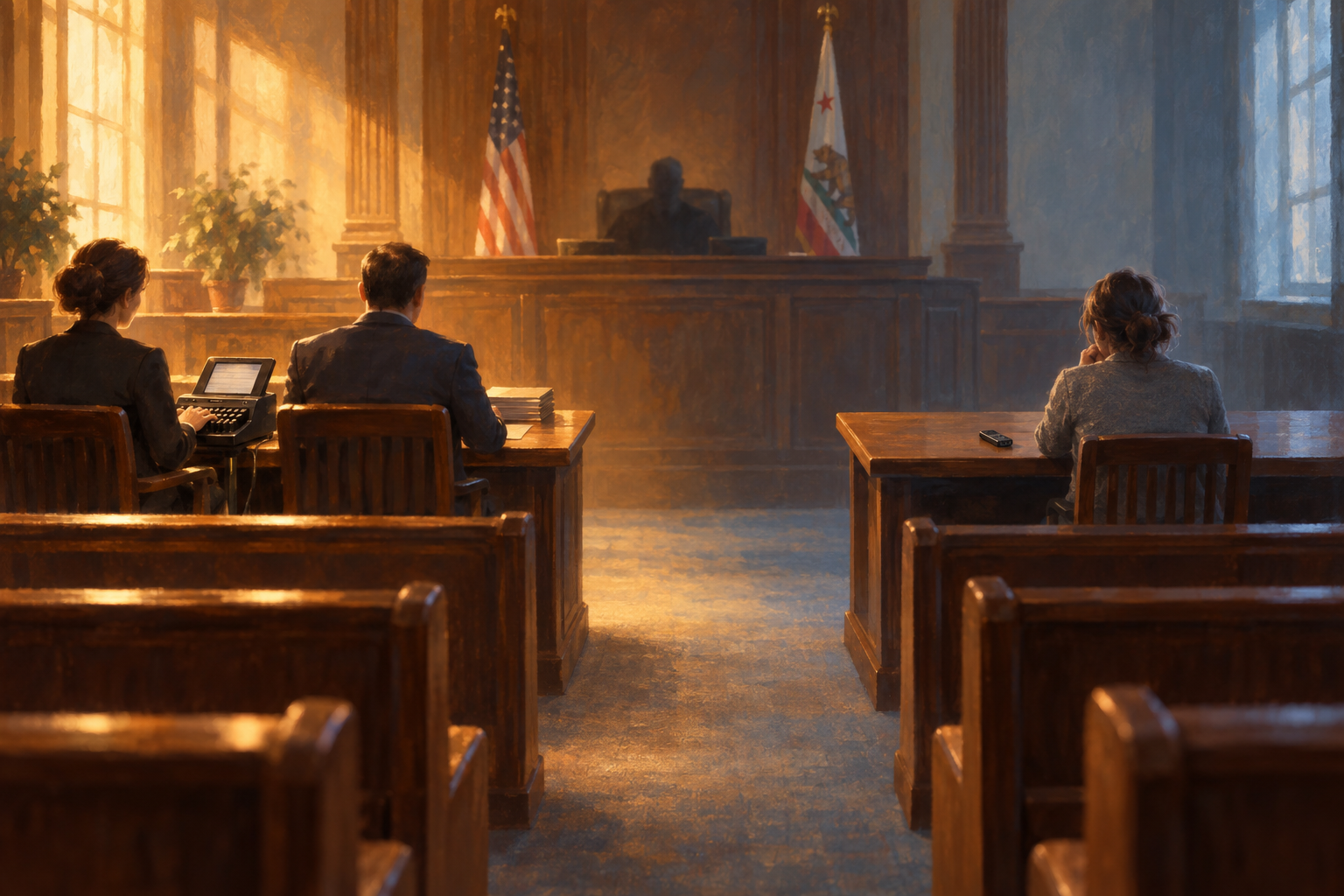
In light of the national shortage of court reporters, the California Supreme Court now holds the statutory prohibition on audio recordings of court proceedings is not enforceable as written. But the reasons and results in Family Violence Appellate Project v. Superior Court (Cal. Aug. 10, 2026, No. S288176) are not what you might expect, because the relief from the shortage runs only to indigent litigants.
So imagine two litigants appear for their trials, and neither can find a court reporter. The only difference: the first also can't afford a court reporter. Both point out that, since Covid, the courtroom is fully outfitted with microphones and modern digital recording equipment, and they want to use that to make their records for appeal. But there's a problem: by statute—Government Code section 69957—the court is prohibited from making a recording.
Advocates (including this commentator) have long argued this prohibition makes no sense in this situation. Both litigants would prefer to have a court reporter. But money is not the obstacle. There just aren't enough reporters to be had.
So in that sense, the Supreme Court's holding is what most people wanted: the trial court is now mandated to electronically record the trial for the first litigant. The Court held that an appellate record is an equal access issue, and so under its common law authority it may infer an implied-in-law exception to the statutory text for indigent litigants. But the equal-access common law doctrine does not aid the second litigant.
Why the Court chose that authority over the constitutional doctrines the parties briefed comes down to a trade. A constitutional holding could have reached every litigant, but only in fundamental-rights cases. The common law route reaches every civil case, but only indigent litigants. The Court took breadth over reach.
A litigant who asks for an official verbatim record and shows she cannot pay for a private reporter is entitled to one. If no reporter is available, the court must record the proceeding electronically. The duty is ministerial—courts have "no discretion" to decline.
Government Code section 69957 forbids electronic recording in every case (except limited civil, misdemeanor, and infraction matters). Despite equal-protection and due-process challenges, the Court did not hold the statute unconstitutional. Instead, it inferred an exception, drawing on the common law in forma pauperis power and the rule that only "the plainest declarations of legislative intent" will curtail it. (Majors v. Superior Court (1919) 181 Cal. 270, 276.)
Because this is a common-law test, indigency is measured loosely—against the invoice rather than against a poverty line. Footnote 3 disclaims "some absolute standard of indigency," extends the right to "any litigant who cannot reasonably afford the costs necessary to access the judicial process," says the population who can pay routine fees but not a reporter "may be large," and requires no fee waiver application.
Watch that space. Any litigant on a budget now has an argument.
Had the Court employed constitutional doctrine, the right might apply only where constitutionally protected interests were at stake. For example, three of the four respondent courts—Los Angeles, Santa Clara, and Contra Costa—had based their local recording rules on constitutional principles, authorizing recording only where fundamental rights or liberty interests were at stake, and only on six factual findings. One of those findings is worth noting: Los Angeles required that the requesting party "has been unable to secure the presence of a private CSR to report the proceeding because such CSR was not reasonably available or on account of that party's reasonable inability to pay." Unavailability or inability to pay. Either one.
The Supreme Court held these orders "fall short of what Jameson and the in forma pauperis doctrine require," because neither doctrine stops at fundamental rights. Because the rule is based on common law, the duty to record runs in every civil case. So a commercial fee dispute qualifies as readily as a restraining order.
Here's the risk—which the Court does not address (see the comments below). Because the Legislature prohibits electronic recordings as the foundation of the appellate record, there exist no statutory remedies for what happens if those recordings fail.
So imagine your next trial is being recorded electronically rather than by a stenographer. The microphones miss a speaker who has drifted too far away. Cross-talk or a mumbled answer defeats the transcriber. The recording attributes the answer to the wrong witness. Passages come back inaudible. The clerk minding the machine is pulled to other duties.
Do any of these record gaps create an irregularity in the proceedings, judicial error, or grounds for a new trial or mistrial? Who bears responsibility? How does a litigant preserve the issue for challenge—by motion, writ, or appeal? None of that is in the opinion, but all of it is coming.
Now that the Court has grafted a fragile extra-statutory remedy onto a core function, expect a run of decisions bolting on judicial fixes, exceptions, and calibrations.
Ask in writing. The duty is request-triggered, and the reason the request must be written is the same reason you want the recording: with no reporter in the room, an oral request leaves no trace. File a request for an official reporter and, alternatively, for an electronic recording, far enough ahead that the clerk answers before the hearing.
Make both showings, and keep them separate. Inability to pay is measured against the bill, so give the day rate, the expected length of the proceeding, and the client's circumstances—not just a conclusion. Unavailability is a different showing: state how many reporters you tried to retain, on what dates, which agencies and individuals you contacted, and what they told you.
If the court refuses, file a writ. A ministerial duty means no deference, and a record denied after a proper request is an irregularity in the proceedings.
And treat the recording with care: speak into the microphone; ask the clerk at the outset of each proceeding whether the equipment is on; and for any sidebars or other colloquies away from the microphones, put it on the record when you return to counsel table.
I have argued for years that California should allow electronic recording, in an article in California Litigation critical of section 69957 A Day Without a Court Reporter and on the podcast with the immediate past president of the California Deposition Reporters Association Humans Get Humans (Better Than Electronic Recordings), with Stephanie Leslie. I thought I wanted this outcome, but now I have misgivings.
The asymmetry is the clue that something is amiss. We face a court-reporter shortage, and it affects everyone. Using an equal-access doctrine is a strange way to reach a remedy for one group and not another.
Digging deeper, common law is a strange source for a rule that requires courts to deploy electronic recording equipment. Start with a case the opinion itself cites. Footnote 4 cites Ferguson v. Keays (1971) 4 Cal.3d 649, 656, footnote 6, for skipping the constitutional questions—and footnote 6 does exactly that, reserving due process and equal protection, because an inherent power resolved the case.
But Ferguson reached its inherent power only after doing the work FVAP skipped. Quoting Martin v. Superior Court (1917) 176 Cal. 289, 296–297, it held that courts exercise only those common law powers "not otherwise repugnant to or inconsistent with our Constitution and statutes," and that inherent powers "should never be exercised in such a manner as to nullify existing legislation or frustrate legitimate legislative policy." (4 Cal.3d at p. 654.) It then examined the fee statutes and found that "[n]one of these various provisions pertains to the subject of the payment of filing fees by indigent persons; none expressly denies to the appellate courts the power to waive those fees"—so that "until the Judicial Council or Legislature has spoken on the subject, the courts properly may exercise their inherent power." (Id. at p. 656.)
But section 69957 is the Legislature speaking directly and categorically on the very subject at issue. FVAP took Ferguson's footnote but not its holding.
In City of Los Angeles v. PricewaterhouseCoopers, LLP (2024) 17 Cal.5th 46, the Court upheld monetary discovery sanctions but grounded the power in statute, warned the authority "is not limitless," called it "cabined," and tempered it with "requirements of causation and reasonableness." There is no analog to the FVAP Court’s use of inherent authority to mandate the form and technological mode of record preparation.
Common-law doctrines are quasi-legislative. They turn on root causes and downstream effects. It is why this Court has refused to create new common-law remedies when the weighing belonged elsewhere. Foley v. Interactive Data Corp. (1988) 47 Cal.3d 654 declined to create a new tort remedy after weighing consequences, and explained why: "Legislatures, in making such policy decisions, have the ability to gather empirical evidence, solicit the advice of experts, and hold hearings at which all interested parties may present evidence and express their views." (Id. at fn. 31.) Moradi-Shalal v. Fireman's Fund Ins. Companies (1988) 46 Cal.3d 287 is the worked example: a section headed "Adverse Consequences" canvassing what the prior judge-made rule had done to the field, and the conclusion that a "difficult weighing of competing policies" is "more properly made by the Legislature."
But here, the Court announced a new common law rule without the examination of root causes it has previously required. FVAP said it "need not in this proceeding investigate the various causes" of the shortage and "need not consider the comparative risks and benefits of the two approaches."
And the root cause is the only thing that changed. The last time California courts confronted electronic recording, the answer was no. The Judicial Council promulgated rules letting superior courts record, the reporters' union sued, and two Courts of Appeal held the Legislature intended to bar recording except where explicitly allowed, invalidating rules inconsistent with that intent. (California Court Reporters Assn. v. Judicial Council (1995) 39 Cal.App.4th 15; (1997) 59 Cal.App.4th 959.) That was deference to the Legislature, and nothing in the statute has changed since. What has changed is the crisis—the one fact distinguishing 1997 from 2026, and the one fact the Court said it need not examine. Neither CCRA decision appears anywhere in FVAP, and neither does PwC. Footnote 5 even answers the accuracy objection by pointing to rules 2.952 and 2.954—Judicial Council rules, promulgated for the categories section 69957 authorizes, whose extension past those categories is the very thing CCRA forbade.
The newly announced common law of California now requires courts to deploy available technology to ensure that lack of personnel does not deny equal access to poor litigants. So consider where else that reasoning runs:
FVAP reaches all of these because its test asks one question: would this litigant otherwise lose equal access? It does not ask whether the technology is accurate enough, whether the Legislature considered it and said no, or whether a court is the right body to decide. Nothing in the test distinguishes based on technology type.
Above I speculate that the Judicial Council will need to revise the APP-003 form to allow appellants to opt for an electronic recording. But do not expect a revised Judicial Council form to clean up the questions about the transcript for the appeal. A court reporter charges two fees—one to attend and report the trial, and a second fee to prepare the transcript. FVAP addresses only the first. The record on appeal is the second. So does the inability-to-pay finding apply to both fees, or only the first? If the second takes a separate showing, then on whose motion, made when? Must the transcript of the electronic recording be certified—or may an indigent litigant run the audio through some AI transcription tool?
Then there is the litigant who could afford a reporter through trial and is tapped out by the time the transcript comes due. She has daily and rough transcripts—at least as credibleas an audio file. Can she get a later showing of inability to pay for a certified transcript? Are the rough transcripts good enough for the common law? (By the way, reporters keep their own backup audio of the proceedings they report—section 69957 does not prohibit that recording. Can an indigent litigant demand it?)
Remember the litigant I mentioned at the top, the one who wants to pay for a court reporter but can't find one? That litigant is not covered because the Court's test is comparative: it asks whether an indigent litigant loses "the equal access to justice that in forma pauperis status was intended to afford." A litigant who can pay suffers no wealth disparity, so nothing in the opinion reaches him. And he is not a figure I invented for the sake of argument. Los Angeles put him in its general order alongside the litigant who cannot pay. The superior courts closest to the shortage thought a party who cannot find a reporter at any price was real enough to write a prong for. The Supreme Court's rule has no such prong. The orders were narrower than FVAP on case type and broader on who qualifies; the Court widened the first and narrowed the second. That is the cost of building an appellate record on a doctrine that protects only the poor.
Whether an appellate record should depend on a poor party happening to be in the room is a question for the next case—and there will be one.