Kowal Law Group Logo

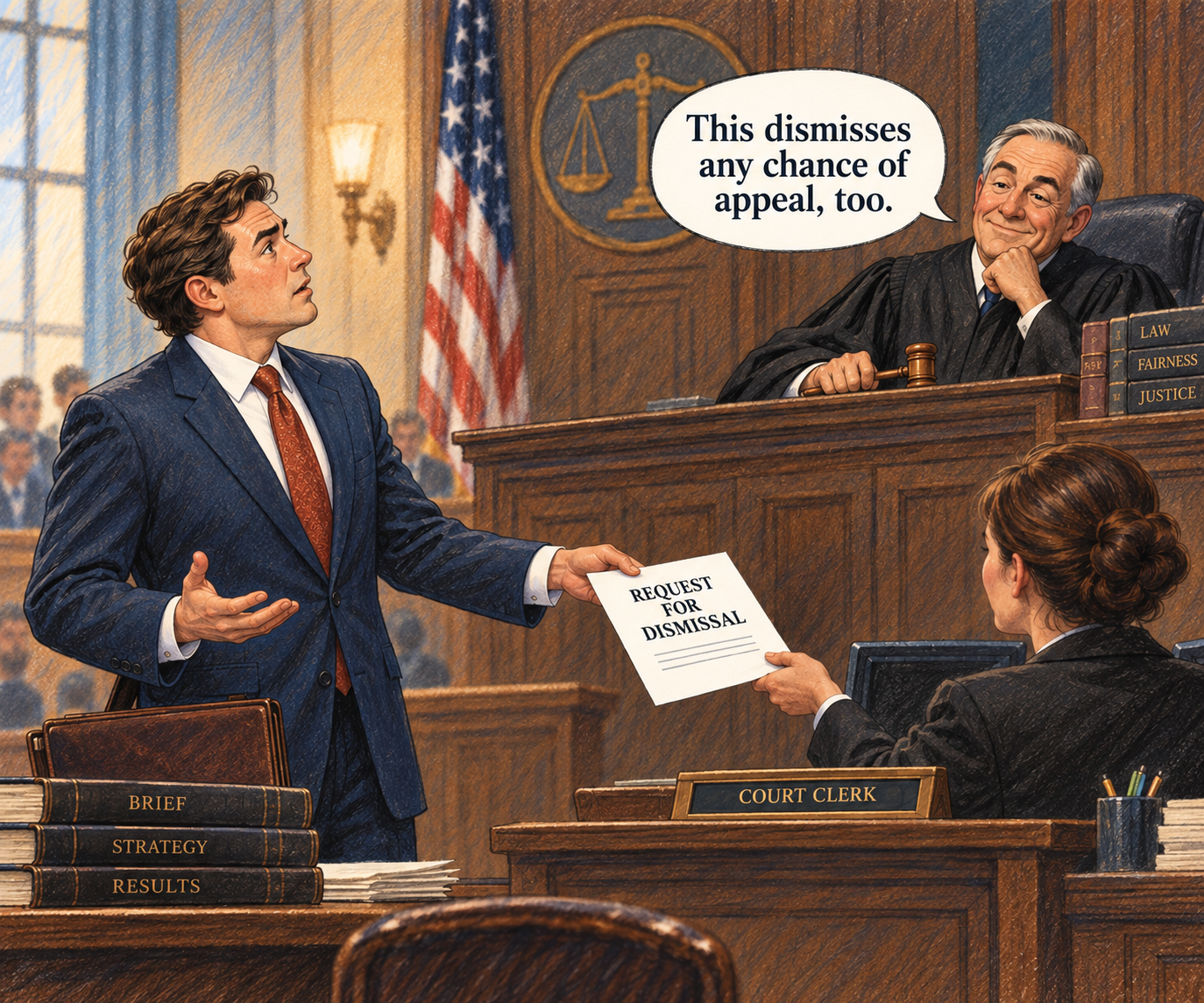
A Voluntary Dismissal Dismisses Your Appeal, Too

William Hernandez     September 10, 2026

A demurrer guts your case, and the only claim that survives isn't worth a trial. What do you do? For two decades, California lawyers answered this problem by voluntarily dismissing what was left and appealing from the dismissal. The Supreme Court closed that door in Maniago v. Desert Cardiology Consultants' Medical Group (Cal. July 16, 2026, No. S290188).

What the Court Says You Must Do Now

Glenn Maniago worked as a surgical technologist. During a cardiac procedure, a physician discarded a syringe of HIV-positive blood into Maniago's eyes instead of the safety bucket. He and his wife sued on several theories. The trial court sustained a demurrer to most of them with leave to amend, struck punitive damages, fees, and prejudgment interest, and left a single negligence claim standing—shrinking the case to ordinary MICRA damages. That ruling was the case.

Counsel avoided the known Kurwa trap: rather than dismiss the remainder without prejudice and preserve them under a tolling deal (the move the Court rejected as manufactured jurisdiction in Kurwa v. Kislinger (2013) 57 Cal.4th 1097), he dismissed with prejudice, reserved nothing, and filed a declaration disclosing that the sole purpose was to expedite appeal. He had solid authority behind that move—Ashland Chemical Co. v. Provence (1982) 129 Cal.App.3d 790, Austin v. Valverde (2012) 211 Cal.App.4th 546, Flowers v. Prasad (2015) 238 Cal.App.4th 930, and Stewart v. Colonial Western Agency, Inc. (2001) 87 Cal.App.4th 1006 all treated a dismissal like his as appealable. But Yancey v. Fink (1991) 226 Cal.App.3d 1334 said the opposite: a voluntary dismissal is a clerk's ministerial act, and a plaintiff isn't aggrieved by her own dismissal. That conflict is what drew review.

The holding: dismiss before the trial court finally resolves any pleaded claim, and the dismissal terminates the action and forfeits the right to appeal. The clerk's entry adjudicates nothing—there's no judgment to appeal from. Austin and Flowers are disapproved outright; the Stewart passage is disapproved to the extent it says otherwise. Pull all three from your form file.

The fix. If you're stuck with a gutted complaint, get to a real judgment instead:

  1. Let the amendment period run, then move under Code of Civil Procedure section 581, subdivision (f)(2), for a signed order on the demurred claims—under section 581d, that's a judgment as to those claims.
  2. Voluntarily dismiss the remaining viable claims (with prejudice is safest).
  3. Request a final judgment, then appeal from that.

A writ petition is the fallback, but the odds of a grant are low.

Left open. The Court didn't decide whether an appeal can lie from a dismissal that follows an order resolving the entire case. That leaves multi-party cases exposed: if one party's claims die on summary adjudication (not independently appealable) and the rest end later by another party's voluntary dismissal, no judgment is ever entered—and because the appeal clock runs from notice of an appealable order, you can't be sure your time to appeal isn't already running.

Tim Kowal is an appellate specialist certified by the California State Bar Board of Legal Specialization. Tim helps trial attorneys and clients win their cases and avoid error on appeal. He co-hosts the Cal. Appellate Law Podcast at CALpodcast.com, and publishes summaries of cases and appellate tips for trial attorneys. Contact Tim at Tim@KowalLawGroup.com or (949) 676-9989.
Get “Not To Be Published,” a weekly digest of these articles, delivered directly to your inbox!
Subscribe

Show neither partiality to the weak nor deference to the mighty, but judge your fellow men justly.

— Leviticus

"Moot points have to be settled somehow, once they get thrust upon us. If an assertion cannot be proved, then it must be settled some other way, and nearly all of these ways are unfair to somebody."

—T.H. White, The Once and Future King

"So far as the beginnings of law had theories, the first theory of liability was in terms of a duty to buy off the vengeance of him to whom an injury had been done whether by oneself or by something in one's power. The idea is put strikingly in the Anglo-Saxon legal proverb, 'Buy spear from side or bear it,' that is, buy off the feud or fight it out."

— Roscoe Pound, An Introduction to the Philosophy of Law

"Do not worry about people stealing your ideas. If your ideas are any good, you'll have to ram them down people's throats."

— Howard H. Aiken

"Good people do not need laws to tell them to act responsibly, while bad people will find a way around the laws."

— Plato (427-347 B.C.)

"At common law, barratry was 'the offense of frequently exciting and stirring up suits and quarrels' (4 Blackstone, Commentaries 134) and was punished as a misdemeanor."

— Rubin v. Green (1993) 4 Cal.4th 1187

"A judge is a law student who grades his own papers."

— H.L. Mencken

"God made the angels to show Him splendor, … Man He made to serve Him wittily, in the tangle of his mind."

— Sir Thomas More in Robert Bolt's A Man for All Seasons

"Upon putting laws into writing, they became even harder to change than before, and a hundred legal fictions rose to reconcile them with reality."

— Will Durant

“It will be of little avail to the people, that the laws are made by men of their own choice, if the laws be so voluminous that they cannot be read, or so incoherent that they cannot be understood; if they be repealed or revised before they are promulgated, or undergo such incessant changes that no man, who knows what the law is today, can guess what it will be tomorrow. Law is defined to be a rule of action; but how can that be a rule, which is little known, and less fixed?”

— James Madison, Federalist 62

"It may be that the court is thought to be excessively legalistic. I should be sorry to think that it is anything else."

— Hon. Sir Owen Dixon, Chief Justice of Australia

"Counsel on the firing line in an actual trial must be prepared for surprises, including requests for amendments of pleading. They cannot ask that a judgment afterwards obtained be set aside merely because their equilibrium was slightly disturbed by an unexpected motion."

— Posz v. Burchell (1962) 209 Cal.App.2d 324, 334

menuchevron-down linkedin facebook pinterest youtube rss twitter instagram facebook-blank rss-blank linkedin-blank pinterest youtube twitter instagram